5. Language mapping for OpenSplice RMI
Rmipp compilation follows a set of mapping rules to generate language-specific source code. Most of these rules come from the standard OMG IDL-to-C++ and IDL-to-Java mapping specifications but with some specific differences. This chapter focuses on specific parts of this mapping. For more information, please refer to the relevant OMG specifications.
The following figure shows the language mapping of the HelloService
IDL interface previously defined.
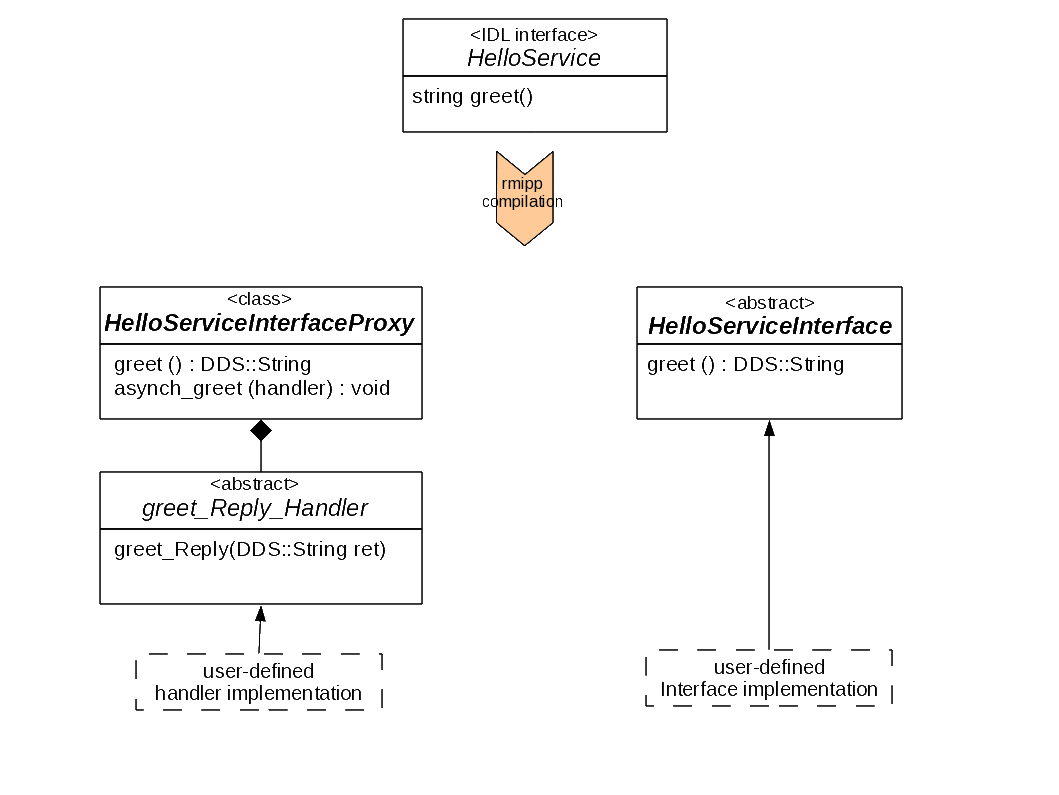
IDL Interface Mapping
5.1. Mapping for interfaces
An interface is mapped to two C++ (or Java) classes that contain public definitions of the operations defined in the interface.
The HelloServiceInterface abstract class is the base class of the
HelloService implementation class. The HelloServiceInterfaceProxy
class is the proxy object that represents locally the remote service.
The client application should get a reference to this class to be able
to invoke the remote service.
5.2. Mapping for operations
Each IDL operation, if not oneway, is mapped to two C++ functions
(Java methods). The first one, having the same name as the IDL operation,
is used for synchronous invocations. The second one, having async_
concatenated to the IDL operation, is used for asynchronous invocations.
A oneway operation maps only to the synchronous form of the operations.
The operations parameters and return types obey the same parameter
passing rules as for the standard OMG IDL-to-C++ and IDL-to-Java mapping.
The asynchronous functions (methods) will return void and take only the
in/inout parameters of the IDL operation, as well as a callback object
used as a reply handler. This handler class is also generated for each
non-void operation as an inner abstract class of the proxy class as
depicted in the diagram with the greet_Reply_Handler class. This
latter should be implemented by the user to handle the asynchronous
invocation reply. Hence, the greet_Reply function (method) provides
all the inout/out/return parameters of the corresponding IDL operation.
5.3. Mapping for basic types
The table below shows the ‘C++ and Java’ mapping of the IDL types that can be declared in the RMI services description file.
IDL sequences are mapped as specified by the DDS standard.
Mapping for basic types
IDL type |
C++ |
Java |
|---|---|---|
boolean |
DDS::Boolean |
boolean |
char |
DDS::Char |
char |
octet |
DDS::Octet |
byte |
short |
DDS::Short |
short |
unsigned short |
DDS::UShort |
short |
long |
DDS::Long |
int |
unsigned long |
DDS::ULong |
int |
long long |
DDS::LongLong |
long |
unsigned long long |
DDS::ULongLong |
long |
float |
DDS::Float |
float |
double |
DDS::Double |
double |
string |
DDS::String |
String |


Please be aware that the RMI middleware assumes ownership of any
DDS::Stringthat is provided to it (either by an in/inout argument or return value). This also means that it’ll free the given string. This can cause issues when the application keeps using the provided string after the RMI call or if RMI is called with a const string literal. It is advised to applyDDS::string_dup(str)when using strings in conjunction with RMI. This is also applicable to sequences of strings.